
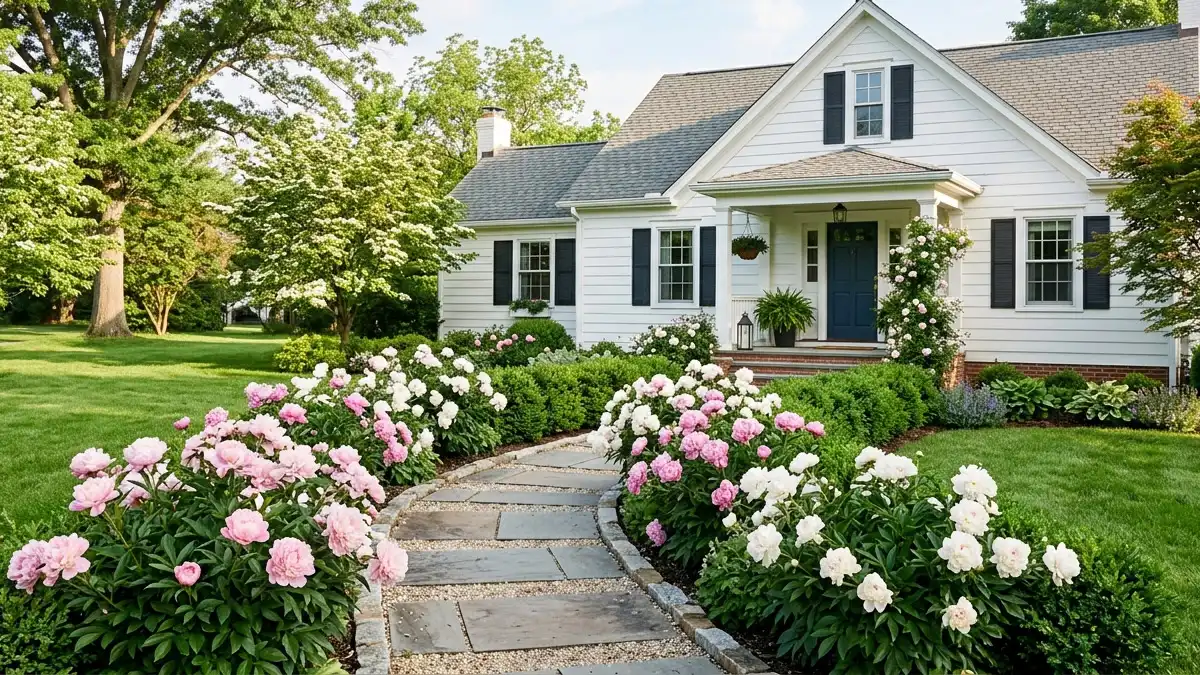
🌸 Quick Answer
Place peonies where they get morning sun and good airflow – near walkways, foundation beds, or as a focal point. Pair with evergreens for winter structure. Choose colors that complement your house. Use support rings to keep blooms upright. After flowering, low companion plants hide fading leaves.
Your front yard is the first thing people see – and nothing says “charming home” quite like peonies in full bloom. These lush, romantic flowers create instant curb appeal that few other perennials can match. But placing peonies in a front yard is different from tucking them into a backyard border. You have to consider visibility, foot traffic, house color, and year‑round appearance.
The good news? Peonies are surprisingly versatile. Whether you have a sprawling suburban lawn or a tiny urban plot, there is a front‑yard peony layout that works. This guide walks you through real, practical ideas – from cottage garden clusters to minimalist modern designs – so you can boost your home’s curb appeal without creating extra maintenance headaches.
Why Peonies Work So Well in Front Yards
Peonies check every box for front‑yard landscaping:
- Seasonal wow factor: For 2–3 weeks in late spring, peonies become the undisputed stars of the street. Their large, fragrant blooms draw the eye from sidewalks and driveways.
- Low maintenance once established: After the first few years, peonies need very little attention – perfect for busy homeowners.
- Four‑season structure: Even when not blooming, peony foliage provides a neat, mounded shape from spring through summer. In fall, the leaves turn bronze or burgundy before dying back.
- Deer resistance: Unlike hostas or tulips, peonies are rarely bothered by deer (see our [peony deer resistance note](internal link – future article). That matters for many suburban front yards.
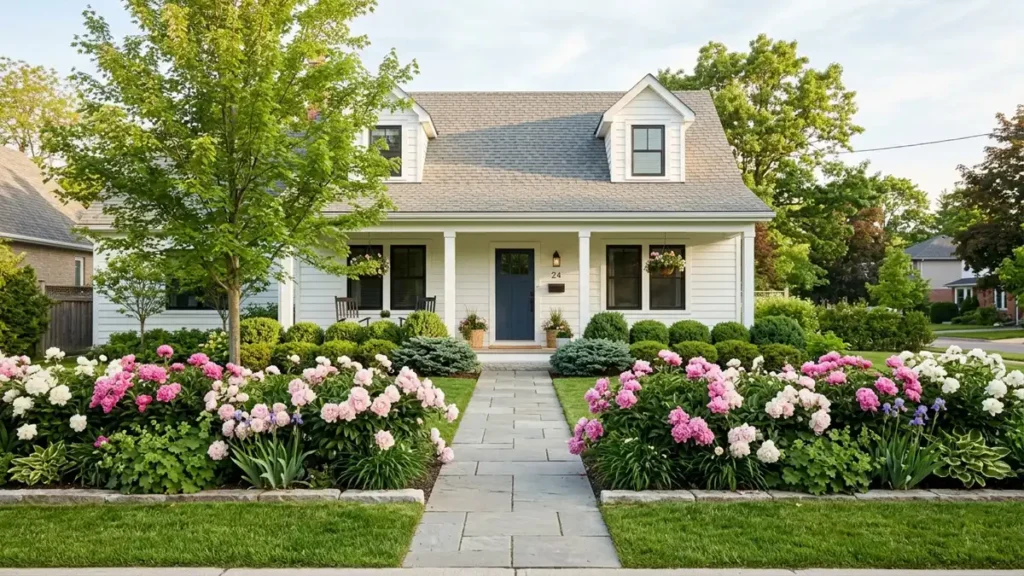
The only downside: After flowering, peony foliage can look a bit messy. But smart companion planting (see Article 2 of this cluster) easily hides spent leaves.
🏡 For more front‑yard inspiration, see our landscape planning guide.
Best Places to Position a Peony Bush
Placement determines whether your peonies thrive or just survive. Here are the best front‑yard spots:
| Location | Pros | Cons | Best For |
|---|---|---|---|
| Near the front walkway | High visibility, welcoming | Risk of being brushed by visitors | Wider walkways (4+ feet) |
| Flanking the front door | Symmetrical, classic look | May block view if too tall | Compact varieties |
| Along the driveway edge | Defines space, easy to see | Heat from asphalt can stress plants | Morning sun locations only |
| In a foundation planting bed | Ties house to landscape | Need good airflow away from walls | East‑facing or north‑facing beds |
| As a focal point in the lawn | Stunning standalone feature | Requires mowing around it | Large front yards |
Avoid: South‑facing walls in hot climates (reflected heat), low spots where water pools, and areas shaded by large trees.
☀️ For detailed placement advice, see our guide: Best Place to Plant a Peony Bush for Maximum Blooms – Growing Conditions.
Border Planting Ideas With Peonies
Peonies shine in perennial borders. Here are three classic border layouts:
Layout 1: The Classic Edge
- Back row: Tall evergreens or shrubs (e.g., boxwood, spirea).
- Middle row: Peonies spaced 3–4 feet apart.
- Front row: Low‑growing perennials (catmint, salvia, geraniums).
Effect: Layered, structured, and tidy year‑round. Peonies pop against the green backdrop.
Layout 2: The Cottage Ribbon
- Plant peonies in a sweeping, curved ribbon along the property line or walkway.
- Intersperse with spring bulbs (daffodils, alliums) and summer bloomers (daylilies, coneflowers).
Effect: Informal, romantic, and high‑impact. Works well for older homes or country‑style gardens.
Layout 3: The Minimalist Row
- Plant a straight row of identical peonies (same color, same variety) 4 feet apart.
- Use gravel or turf between plants.
- No other flowers – just the peonies.
Effect: Modern, clean, and dramatic. Best with white or soft pink peonies.
🌸 For variety recommendations, see our guide: Best Peony Bush Varieties for Home Gardens).
Mixing Peonies With Evergreens
Evergreens provide structure when peonies are dormant. This pairing is especially valuable for front yards, where winter appearance matters.
Best evergreen companions:
- Boxwood (Buxus): Low, rounded shrubs that frame peonies beautifully. Plant boxwood 2–3 feet in front of peonies.
- Dwarf spruce or juniper: Adds texture and winter interest. Place on the north or east side of peonies to avoid shading.
- Holly (Ilex): Glossy leaves and red berries contrast with peony flowers. Plant at least 4 feet away to prevent root competition.
Design tip: Plant evergreens as a backdrop (behind peonies) or as a low hedge (in front). Avoid planting evergreens on the south side – they will shade peonies.
For more companion ideas, see our upcoming best companion plants for peony bushes.
Cottage Garden Style Layouts
Cottage gardens are chaotic and romantic – but they still need structure. Here is a peony‑focused cottage layout for a 10×10 foot front yard bed:
Back (tall, airy):
- Delphinium or foxglove (blue/purple)
- Ornamental grasses
Middle (main focal point):
- 3 peony bushes (mix of pink, white, and coral)
- Spacing: 3 feet apart
Front (low, sprawling):
- Catmint (Nepeta) – lavender blue
- Hardy geraniums – pink or white
- Lady’s mantle (Alchemilla) – chartreuse foliage
Edging (trailing):
- Creeping thyme or alyssum
Effect: Layers of color and texture from late spring through summer. When peonies finish, the front plants hide their fading leaves.
🪴 For more on cottage aesthetics, stay tuned for our upcoming guide: Cottage Garden Ideas With Peony Bushes.
Minimalist Landscaping With Peonies
Minimalism = clean lines, few species, and strong contrasts. Peonies can work in modern landscapes.
Minimalist layout:
- Plant 3–5 identical peonies (all same color – white ‘Festiva Maxima’ or soft pink ‘Sarah Bernhardt’) in a precise row or grid.
- Use a uniform ground cover: gravel, black mulch, or dwarf mondo grass.
- No other flowering plants – just the peonies.
- Add a contemporary hardscape element: a large boulder, steel edging, or a concrete bench.
Why it works: The repetition and restraint make the peony blooms hit harder. The rest of the year, the clean geometry carries the design.
Best peonies for minimalist gardens: White or soft pink single or Japanese types (‘Krinkled White’, ‘Bowl of Beauty’). Avoid very bright reds or double bomb types – they feel less modern.
🎨 For color selection, see our guide: Pink, White, or Red? Choosing the Right Peony Bush Color for Your Garden.
Using Peonies Around Walkways and Entryways
Peonies near walkways create a welcoming, fragrant entrance – but you need to avoid common pitfalls.
Do:
- Plant at least 1.5–2 feet back from the walkway edge to prevent stems from flopping onto the path.
- Choose compact varieties (‘Early Scout’, ‘Little Red Gem’) for narrow walkways.
- Use support rings to keep blooms upright and off passing shoulders.
- Plant on the east side of a south‑facing walkway (morning sun, afternoon walkway shade).
Don’t:
- Plant peonies that will grow 3+ feet wide within 12 inches of the walkway.
- Use varieties with very heavy double blooms that require constant staking.
- Plant right next to a sidewalk that receives de‑icing salt in winter (salt damages peonies).
Entryway flanking: Plant one peony on each side of your front door or porch steps. Use identical varieties for symmetry. Ensure they receive at least 6 hours of morning sun.
🌿 For more entryway design, see our garden decor guide.
Small Front Yard Peony Layout Ideas
Limited space does not mean no peonies. Here are three small‑yard layouts:
Idea 1: Single Specimen
- Plant one peony in the center of a small front bed (4×4 feet minimum).
- Surround with low evergreen ground cover (creeping phlox, vinca minor).
- Keep the rest of the bed minimalist.
Idea 2: Corner Accent
- Place a peony in a front corner of the house foundation bed.
- Angle it so it is visible from both the street and the front door.
- Pair with a small evergreen on the opposite side for balance.
Idea 3: Container Peony on Porch
- Use a large pot (18+ inches wide) on your front porch or stoop.
- Choose a dwarf variety (‘Pixie’, ‘Little Red Gem’).
- Move the pot to the side after blooming if foliage gets messy.
- Overwinter the pot in an unheated garage (see our [peonies in pots guide](internal link – Growing Conditions Article 2)).
For small garden design, stay tuned for our upcoming guide: Small Garden Design Ideas Using Peony Bushes.
Best Peony Colors for Curb Appeal
Your house color should influence your peony choice. Here is a quick guide:
| House Exterior | Best Peony Colors | Why |
|---|---|---|
| White or cream | Soft pink, coral, red | Adds warmth and contrast |
| Brick (red/brown) | White, soft pink, pale yellow | Avoids clashing; white pops against brick |
| Gray or blue‑gray | White, deep pink, red | All work well; white is most elegant |
| Beige or tan | Coral, pink, white | Warm tones complement beige |
| Yellow or peach | White, lavender‑pink, red | Avoid yellow; white provides contrast |
| Dark blue or navy | White, soft pink, coral | Light colors stand out beautifully |
Universal rule: White peonies work with every house color. If you are unsure, plant ‘Festiva Maxima’ or ‘Duchesse de Nemours’.
🌈 For more on color choices, read our full guide: Pink, White, or Red? Choosing the Right Peony Bush Color for Your Garden.
Common Landscaping Mistakes With Peonies
Avoid these front‑yard errors that can ruin your design:
| Mistake | Consequence | Fix |
|---|---|---|
| Planting too close to the house foundation | Shade from eaves, poor airflow, root competition | Keep at least 2 feet from foundation. |
| Using dark mulch against light‑colored house | Looks harsh, competes with peony blooms | Use natural brown or pine straw mulch. |
| Planting only one color in a large bed | Flat, boring appearance | Repeat colors or add contrast. |
| Ignoring bloom timing | Whole bed blooms together, then nothing | Combine early, mid, and late varieties (see [variety guide](internal link – Comparison Article 2)). |
| Forgetting about post‑bloom foliage | Messy look for months | Underplant with perennials that hide dying leaves. |
| Planting peonies where snow slides off roof | Crown damage from ice and snow | Avoid drip lines and roof valleys. |
🍂 For post‑bloom care, see our guide: What to Do With a Peony Bush After Flowering Ends.
Low‑Maintenance Peony Garden Ideas
Want curb appeal without constant work? Design for low maintenance from the start.
Low‑maintenance front yard peony layout:
- Plant 3–5 peonies of the same easy variety (‘Bowl of Beauty’, ‘Krinkled White’ – no staking needed). Space 4 feet apart.
- Underplant with creeping sedum – low, drought‑tolerant, evergreen in mild climates.
- Edge with steel or concrete pavers – no trimming needed.
- Apply a 2‑inch layer of pine straw mulch – lasts longer than wood chips.
- Remove all foliage in fall – the only required task.
Time per year: Less than 30 minutes for the entire bed.
Avoid: High‑maintenance companions (roses, delphiniums), plants that require division every year, or thirsty annuals.
🧑🌾 For more low‑maintenance reassurance, see our guide: Are Peony Bushes High Maintenance? The Truth for Beginners.