🌸 Quick Answer:
Humidity keeps leaves wet for long periods, promoting fungal diseases like botrytis and leaf blotch. Poor airflow, dense mulch, and evening watering make it worse. Choose single or Itoh peonies, space plants 4 feet apart, water only in the morning at the base, and remove diseased leaves promptly.
You have given your peonies full sun, well‑drained soil, and careful watering. But every summer, the leaves develop black spots, the buds rot before opening, and the plant looks ragged. If you garden in the Southeast, Gulf Coast, or any region with sticky, humid summers, you know the struggle.
Humidity changes everything for peonies. It is not just about heat – it is about moisture that lingers in the air and on leaves for hours or days. That constant dampness creates a paradise for fungal diseases and a nightmare for peony lovers.
This guide explains why humidity is so hard on peonies, which problems to watch for, and how to adapt your care to keep your plants alive and blooming in damp climates.
Why Humidity Is Hard on Peonies
Peonies evolved in regions with cold winters and relatively dry summers – northern China, Siberia, Korea, and the mountains of Japan. They are not adapted to prolonged humidity.
How humidity harms peonies:
- Leaves stay wet longer – Dew and rain evaporate slowly, giving fungal spores hours to germinate and infect.
- Air circulation is naturally reduced – Humid air is denser and moves less, creating stagnant pockets around foliage.
- Spores travel easily – Many peony fungi (botrytis, leaf blotch) thrive in humidity and spread rapidly in damp conditions.
The result: Peonies in humid climates often look diseased by midsummer, even with good care. You may still get spring blooms, but the plant’s energy is drained by constant fungal pressure, leading to fewer blooms the following year.
💧 For more on disease identification, see our guides: Peony Bush Leaves Turning Brown
Common Fungal Problems in Damp Weather
Humidity triggers a cascade of fungal diseases. Here are the most common in humid regions:
| Disease | Symptoms | Humid Weather Connection |
|---|---|---|
| Botrytis blight | Gray mold on leaves, stems, and buds; blackened, rotting buds | Most active in cool, wet, humid springs |
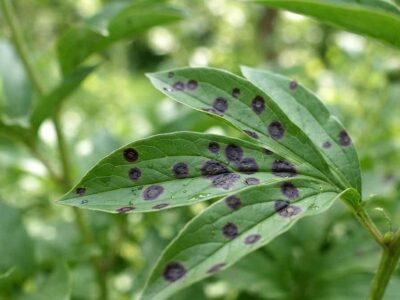
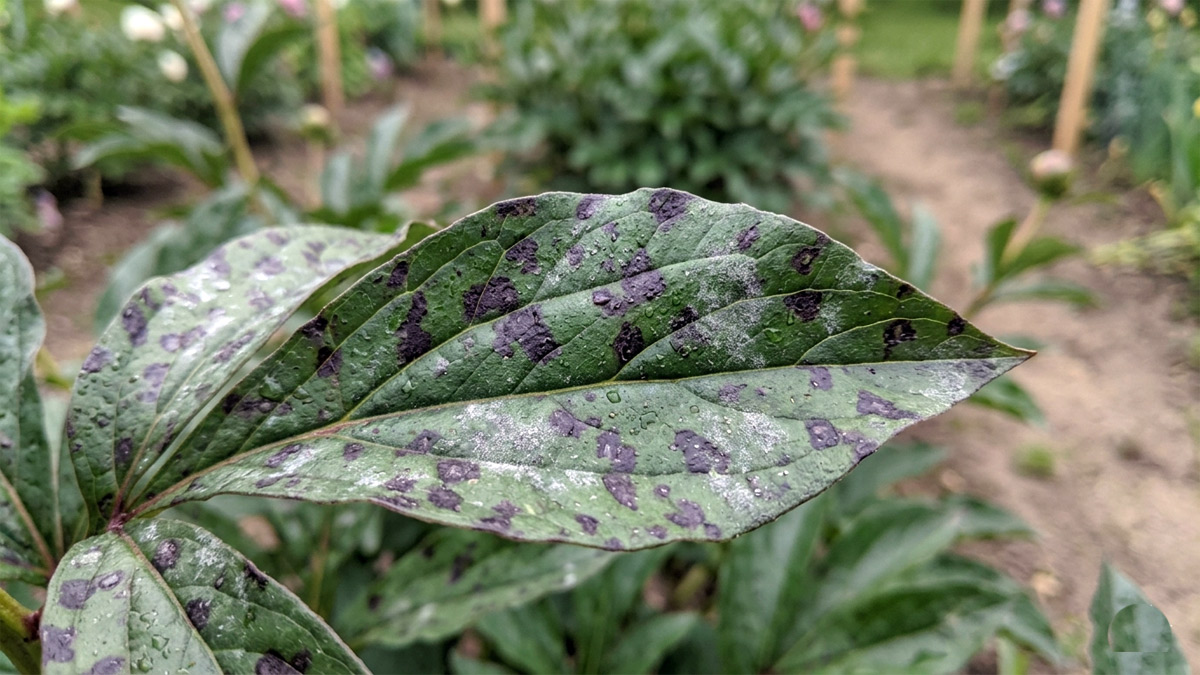
| Leaf blotch (peony measles) | Purple‑black spots on upper leaf surfaces; stems develop dark streaks | Spores splash in rain; humidity prolongs leaf wetness |
| Phytophthora blight | Black, leathery rot on stems and crown; entire stem collapses | Soil‑borne; thrives in warm, wet, humid conditions |
| Powdery mildew | White powdery coating on leaves | High humidity without free water (common in late summer) |
What you see: By July, your peony’s lower leaves may be covered in black spots or white powder. Buds that formed in spring may have turned brown and never opened. This is not your fault – it is the climate.
🦠 For treatment steps, read our Peony Bush Leaves Turning Brown.
Poor Airflow Makes Things Worse
In humid climates, airflow is not a nicety – it is a necessity. Still air + humidity = disease explosion.
Why airflow matters:
- Moving air dries leaf surfaces faster, reducing the time fungi have to infect.
- Airflow lowers the relative humidity immediately around the plant.
- Spores are carried away rather than settling on leaves.
How to improve airflow:
- Space peonies 4 feet apart – not 3 feet. Extra room makes a significant difference.
- Prune nearby shrubs and perennials that block air movement.
- Do not plant peonies against solid walls or fences – leave 2–3 feet of open space.
- Remove lower leaves (the bottom 6–8 inches) in early summer to allow air under the canopy.
- Thin overcrowded stems – if a mature peony has more than 15–20 stems, remove some of the smallest at ground level.
If airflow is still poor: Consider moving peonies to a more open location in fall. A breezy hillside is far better than a sheltered corner.
Watering Mistakes During Humid Summers
In humid weather, how you water is as important as how much you water. Common mistakes can turn a manageable situation into a disaster.
Mistake #1: Overhead watering. Water that lands on leaves adds to the moisture already present from humidity and dew. This extends leaf wetness and spreads fungal spores.
Mistake #2: Evening watering. Watering late in the day means leaves stay wet all night – prime time for fungal infection. Morning watering allows leaves to dry quickly.
Mistake #3: Overwatering. Humid air already slows evaporation from soil. Adding extra water keeps the crown and roots too wet, encouraging rot.
The right approach:
- Water only at the base – use a soaker hose or drip irrigation, or water gently with a wand aimed at the soil.
- Water in the morning (before 9 AM) so any accidental leaf splashes dry by midday.
- Water only when the top 2–3 inches of soil are dry – avoid a set schedule. In humid weather, you may water as little as once every 10–14 days.
💧 For general watering principles, see our watering tips for all plant types.
Why Dense Mulch Can Increase Problems
Mulch is usually beneficial, but in humid climates, it can backfire.
The problem: Thick, dense mulch (shredded bark, wood chips, grass clippings) stays wet for days after rain. That moisture rises as vapor, keeping the lower leaves and crown damp. It also provides a perfect hiding place for fungal spores and slugs.
What to do instead:
- Use a light, loose mulch – pine straw (pine needles), rice hulls, or coarse gravel.
- Apply only 1–2 inches, not 3–4 inches.
- Keep mulch away from the crown – leave a 2–3 inch bare circle around the base of the plant.
- Replace mulch annually – old mulch harbors spores.
In very humid climates (Gulf Coast, Florida): Consider using no mulch at all. Bare soil that drains well is safer than wet mulch against the crown.
🌾 For more on mulch decisions, stay tuned for our upcoming guide: Should You Mulch Around a Peony Bush?
Best Spacing for Humid Climates
Standard spacing recommendations assume average humidity. In humid regions, increase spacing significantly.
| Climate | Minimum Spacing (center to center) | Recommended Spacing |
|---|---|---|
| Arid or semi‑arid | 3 feet | 3 feet |
| Moderate humidity (Midwest, Mid‑Atlantic) | 3–4 feet | 3.5 feet |
| Humid (Southeast, Gulf Coast, Pacific Northwest) | 4 feet | 4–5 feet |
Why spacing matters at 4+ feet: Air can circulate freely between plants. Leaves from neighboring peonies do not touch, so diseases cannot spread by contact. You can walk between plants for inspection and cleanup.
If your garden is small: Grow fewer peonies rather than crowding them. One healthy, widely spaced peony will out‑bloom three crowded, diseased ones.
Morning Watering vs Evening Watering
This deserves its own emphasis. In humid climates, never water peonies in the evening.
| Watering Time | Effect in Humid Weather |
|---|---|
| Morning (before 9 AM) | Leaves dry quickly as temperatures rise. Daytime sun and breeze evaporate moisture within a few hours. |
| Midday | Water evaporates before reaching roots; wet leaves in hot sun can scorch. |
| Evening (after 5 PM) | Leaves stay wet all night. Humidity remains high. Dew adds even more moisture. Fungal spores have 12+ hours to infect. |
If you must water in the evening (no other time possible), water only at the base using a soaker hose – absolutely no overhead watering.
Automated irrigation: Set timers to run between 4 AM and 7 AM. This gives leaves time to dry before nightfall.
Heat + Humidity Stress Signs
When heat and humidity combine, peonies show specific stress symptoms beyond disease.
| Symptom | What It Means | Action |
|---|---|---|
| Leaves curl inward along edges | Plant trying to reduce leaf surface area | Provide afternoon shade. Water deeply in morning. |
| Lower leaves turn yellow and drop | Normal aging may be accelerated by stress | Remove dropped leaves promptly to reduce spore sources. |
| Stems become soft or spongy | Possible bacterial or fungal rot | Cut affected stems to ground. Improve airflow. |
| White powdery coating (mildew) | Powdery mildew – cosmetic but weakening | Increase airflow. Apply sulfur or potassium bicarbonate if severe. |
| New growth is pale or stunted | Root stress from combined heat + moisture | Check drainage. Consider transplanting to better location in fall. |
When to worry: If the crown (base of the plant) becomes soft or black, the peony may be dying. Dig it up and inspect. If rotten, discard and do not replant peonies in that spot for several years.
🌡️ For more on heat stress, see our guide: Why Is My Peony Bush Wilting in Hot Weather?
Best Peony Types for Humid Regions
Some peonies tolerate humidity better than others. Focus on these types:
| Type | Humidity Tolerance | Why | Examples |
|---|---|---|---|
| Single and Japanese peonies | Best | Fewer petals, so less moisture trapped; better air circulation around flowers | ‘Bowl of Beauty’, ‘Krinkled White’, ‘Early Scout’ |
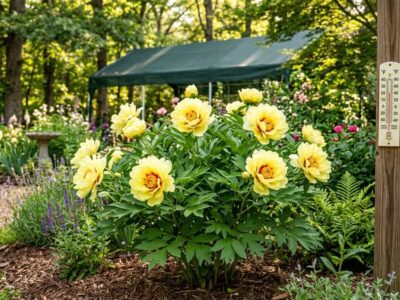
| Itoh (intersectional) peonies | Very Good | Strong stems, disease resistance, leaves hold up better | ‘Bartzella’, ‘Cora Louise’, ‘Kopper Kettle’ |
| Tree peonies | Good | Woody stems keep foliage elevated; better airflow | ‘Kamata‑nishiki’, ‘High Noon’ |
| Double herbaceous peonies | Poor | Dense petals trap moisture; leaves prone to spotting | ‘Sarah Bernhardt’, ‘Festiva Maxima’ (avoid in humid climates) |
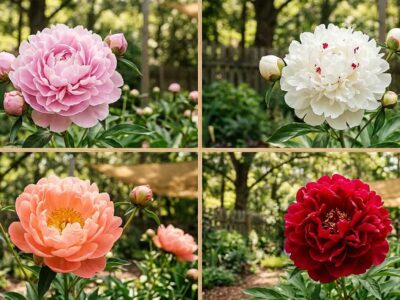
Recommendation for humid regions: Plant single or Itoh peonies. They still bloom beautifully but suffer far less disease pressure than double varieties.
🌸 For more variety information, see our guide on types of peonies flowers.
How to Improve Survival in Damp Gardens
Here is your complete checklist for growing peonies in humid climates:
- ✅ Choose resistant varieties – single, Japanese, or Itoh peonies.
- ✅ Space plants 4 feet apart – more if possible.
- ✅ Plant in raised beds if your soil is heavy clay.
- ✅ Orient beds for maximum airflow – avoid fenced corners or narrow side yards.
- ✅ Water only in the morning, at the base – never overhead.
- ✅ Use light mulch (pine straw) or no mulch – keep crown bare.
- ✅ Remove lower leaves (bottom 6–8 inches) in early summer.
- ✅ Inspect weekly and remove any spotted or moldy leaves immediately – trash them.
- ✅ Cut back and remove ALL foliage in fall – do not compost.
- ✅ Consider preventative fungicide in early spring (copper or chlorothalonil) if disease is severe every year.
Acceptance: Even with perfect care, peonies in humid climates will never look as pristine as those in dry climates. Brown spots and some leaf loss by August are normal. Judge success by spring blooms, not summer foliage.