🌸 Quick Answer
Peonies need at least 6 hours of direct sun for good blooming – full sun is best. In hot climates (Zones 7–8), morning sun with afternoon shade is ideal. In partial shade (3–5 hours), you will get few or no flowers. Morning sun is more valuable than afternoon sun.
You have heard that peonies love sun. But your garden has spots that get morning light only, or afternoon shade from a large tree. Can peonies still bloom there? Or do they absolutely need scorching, all‑day sun?
The answer is more nuanced than a simple yes or no. Peonies are sun‑loving plants – but “full sun” does not mean the same thing in Maine as it does in Texas. Understanding how sunlight affects flower production will help you choose the right spot, whether you have a wide‑open field or a partially shaded suburban yard.
This guide focuses exclusively on sunlight: how much peonies truly need, what happens when they get too little (or too much), and how to adjust for your climate.
How Much Sun a Peony Bush Really Needs
The standard recommendation – at least 6 hours of direct sunlight per day – is accurate for most peonies. But let’s break down what that means in practice.
SUNLIGHT GUIDELINES
- 6 hours is the minimum for decent blooming. With exactly 6 hours, you may get blooms, but they might be smaller or fewer than with more sun.
- 8+ hours is ideal. Peonies planted in all‑day sun produce the largest number of flowers and the strongest stems.
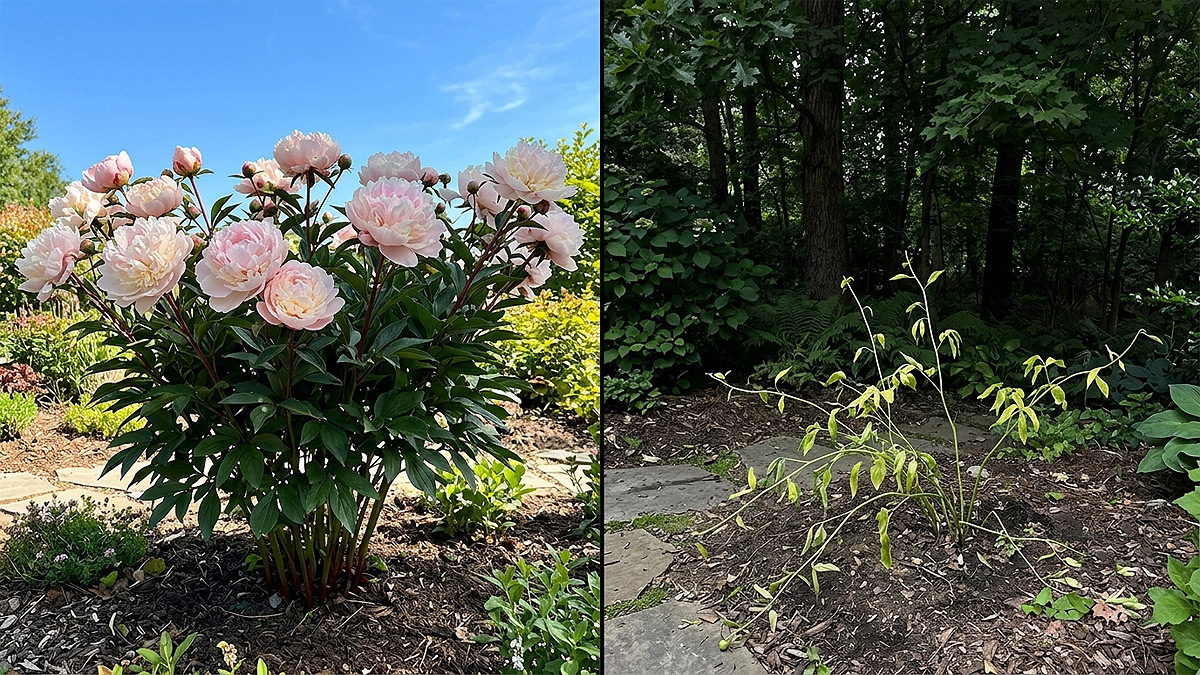
- Less than 6 hours: Bloom count drops sharply. At 4 hours, you may see no flowers at all – just leaves.
What counts as “direct sun”: Unobstructed sunlight. Sunlight filtered through tree leaves, a translucent patio cover, or a window does not count. Shade from a building that moves during the day still reduces total exposure.
Can Peonies Survive in Partial Shade?
Yes, peonies can survive in partial shade – but they will not thrive. The difference is dramatic.
What “partial shade” means: Typically 3–5 hours of direct sun, often with dappled or filtered light the rest of the day.
WHAT HAPPENS IN PARTIAL SHADE
- ✓ Fewer blooms – maybe 1–3 flowers instead of 15–20.
- ✓ Smaller, less vibrant flowers.
- ✓ Weaker, more floppy stems (the plant stretches toward light).
- ✓ Higher risk of fungal disease because leaves stay wet longer.
- ✓ Slower overall growth and smaller plant size.
If partial shade is your only option: Choose early‑blooming varieties that flower before trees leaf out fully. Examples: ‘Early Scout’, ‘Coral Charm’. You may also consider tree peonies, which tolerate slightly more shade than herbaceous types.
Realistic expectation: A peony in partial shade will never look like the one in your neighbor’s full‑sun garden. If blooms are your priority, find a sunnier spot or reconsider planting peonies.
What Happens in Too Much Shade?
When peonies receive fewer than 4 hours of direct sun, the plant shifts into survival mode. Here is what you will see:
| Symptom | Cause |
|---|---|
| No flower buds at all | Insufficient energy for reproduction |
| Long, thin, weak stems (“leggy” growth) | Stretching toward available light |
| Pale green or yellowish leaves | Reduced chlorophyll production |
| Leaves that stay wet and develop mold | Poor air circulation + low light |
| Plant gradually declines over years | Depleted root energy reserves |
Can you fix a peony planted in too much shade? Yes – by moving it. Transplant the peony to a sunnier location in fall (September or October). The plant may skip blooming for 1–2 years after the move, but it will recover.
Is Afternoon Shade Helpful in Hot Climates?
This is where the simple “full sun” rule needs adjustment. In hot climates (USDA Zones 7–9) , afternoon shade is not just acceptable – it is beneficial.
Why afternoon shade helps:
- Prevents leaf scorch (crispy, brown leaf edges).
- Reduces heat stress wilting.
- Conserves soil moisture.
- Extends the life of blooms (flowers last longer in cooler conditions).
The ideal setup for hot climates: Morning sun (6+ hours) with afternoon shade starting around 1–2 PM. An east‑facing location that gets shade from a building, fence, or tree in the afternoon works perfectly.
What to avoid in hot climates: Full, all‑day sun on a south‑ or west‑facing wall. Reflected heat from walls and pavement can push temperatures high enough to stress peonies significantly.
In cool climates (Zones 3–5): Afternoon shade is unnecessary and may reduce bloom count. Full all‑day sun is best.
Morning Sun Benefits for Peonies
Morning sun is the most valuable sunlight peonies can receive – even more important than total hours in some ways.
WHY MORNING SUN IS CRITICAL
- Dries dew and rain quickly: Morning sun evaporates lingering moisture before fungal diseases like botrytis and leaf blotch can take hold.
- Gentle warmth: It warms the plant gradually, avoiding the shock of rapid midday heating.
- Photosynthesis kick‑start: Peonies begin producing vital energy early, leading to much stronger seasonal growth.
If you have to choose between morning sun and afternoon sun: Choose morning sun every time. A peony with 5 hours of morning sun and 2 hours of afternoon shade will often outperform one with 7 hours of afternoon‑only sun.
Testing your site: Check your proposed planting spot at 8 AM, 10 AM, and noon. Is it sunny at 8 AM? That is morning sun. If shade until 11 AM, that spot gets mostly afternoon light – not ideal.
How Trees Affect Peony Growth
Planting peonies near trees is risky – and not just because of shade. Trees compete aggressively for water and nutrients.
The shade problem: Deciduous trees (oaks, maples, birches) leaf out in spring just as peonies are emerging. By the time peonies need full sun for blooming, the tree canopy may already be blocking light.
The root competition problem: Tree roots extend far beyond the drip line (the edge of the canopy). Even if the peony gets sunlight, tree roots will steal water and nutrients.
Minimum distance from trees: 8–10 feet from the trunk of a small tree. 15+ feet from large shade trees.
If you must plant near a tree:
- Choose the east side of the tree (morning sun, afternoon tree shade).
- Install a root barrier vertically between the tree and peony.
- Water and fertilize the peony more frequently.
Better option: Plant peonies in the open, away from all trees.
You May Also Like
Transform Your Outdoor Space with Landscape Planning
Signs Your Peony Needs More Sun
Your peony will tell you if it is light‑starved. Watch for these clues:
| Sign | What It Means |
|---|---|
| Long, pale, spindly stems reaching sideways | The plant is stretching toward light. |
| Dark green leaves but no flower buds after 3+ years | Classic “healthy but no blooms” – usually insufficient sun. |
| Leaves are smaller than normal | Reduced photosynthesis limits leaf size. |
| Plant leans heavily toward one direction | Light source is from that side only. |
| Mildew or leaf spot every year | Poor air circulation + insufficient sun to dry leaves. |
| Blooms appear only on the sunniest side of the plant | The rest of the plant is too shaded. |
If you see these signs: In fall, move the peony to a sunnier location. Do not wait – the plant will continue to decline.
Can You Move a Peony to a Sunnier Spot?
Yes – and if your peony is struggling due to lack of sun, moving it is the only real solution.
Best time to move: Fall (September or October), after the foliage has died back but before the ground freezes.
Step‑by‑step:
- Cut back stems to 4–6 inches (easier to handle).
- Dig a wide circle around the plant (12–18 inches from crown).
- Lift the root ball carefully – peony roots are brittle.
- Replant immediately in a sunnier location at the same depth (eyes 1.5–2 inches below soil).
- Water well and add a light layer of mulch.
What to expect after moving: No blooms for 1–2 seasons. The plant needs time to re‑establish roots. Do not fertilize heavily during this recovery period.
If you cannot move the peony (renting, immovable obstacles): Consider removing nearby plants that cast shade, pruning tree branches (if yours), or accepting that you will have few or no blooms.
Best Sunlight Setup by Climate Region
Use this quick reference for your zone:
| Region (USDA Zone) | Recommended Sunlight |
|---|---|
| Zones 3–4 (Northern US, Canada) | Full all‑day sun (8+ hours). Afternoon shade not needed. |
| Zones 5–6 (Midwest, Mid‑Atlantic, Northeast) | Full sun (6–8 hours). Morning sun preferred. Light afternoon shade acceptable. |
| Zone 7 (Virginia, NC, Tennessee, Arkansas) | Morning sun with afternoon shade (east‑facing spot). Avoid south/west walls. |
| Zone 8 (Texas, Georgia, Pacific Northwest) | Morning sun only (4–6 hours) + bright afternoon shade. Protect from 1–6 PM sun. |
| Zone 9+ (Florida, SoCal desert, Hawaii) | Not recommended for standard peonies. If trying: morning sun only (3–4 hours) + heavy afternoon shade. Consider low‑chill varieties or tree peonies. |