
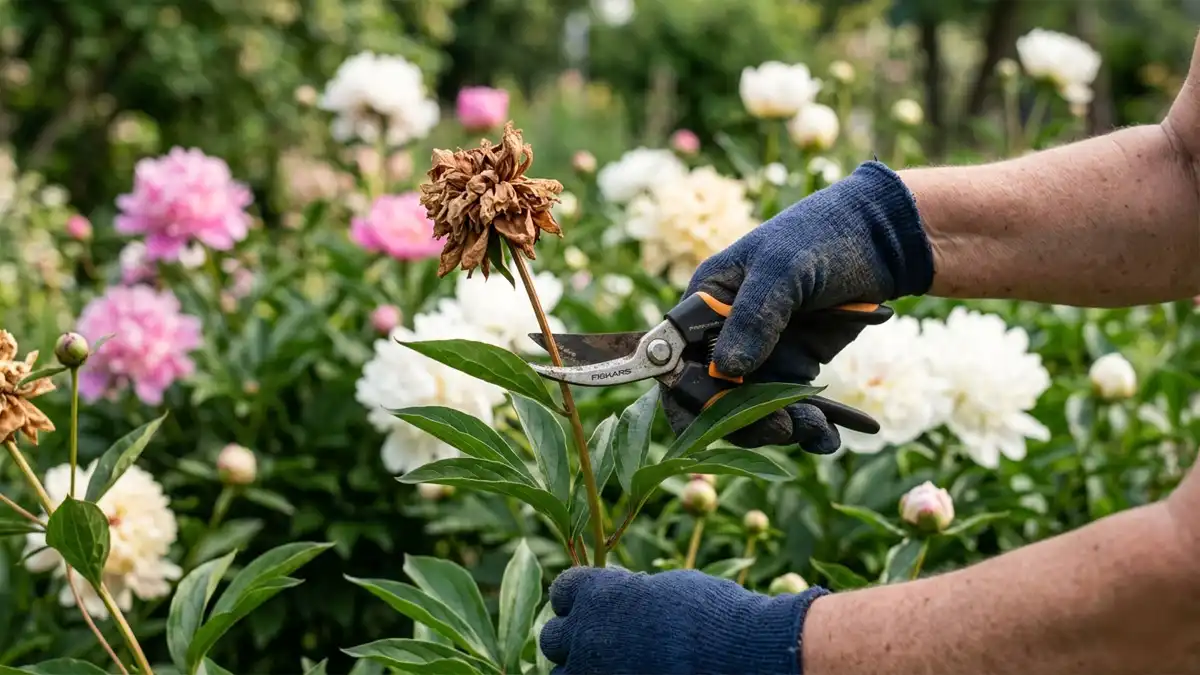
Your peony blooms have faded. The petals are dropping, and the spent flowers look messy. Should you cut them off? Or leave them alone? And is deadheading the same as cutting back the whole plant in fall?
Beginners often confuse these tasks. Deadheading is simple: removing only the faded flowers. Cutting back is removing all stems and leaves in fall. Both are important – but for different reasons.
This guide answers the one question that causes the most confusion: Should you deadhead peonies? The short answer is yes – but how and when matter. Let’s walk through it.
What Does Deadheading Mean?
Deadheading is the practice of removing spent flowers (faded, wilted, or dying blooms) from a plant before they form seeds.
What deadheading is NOT:
- Cutting back the entire plant to the ground.
- Removing leaves or stems (except for the flower stalk itself).
- Pruning for shape or size.
For peonies: You cut off the old flower head, leaving the rest of the stem and all the leaves intact. Think of it as giving your plant a light “haircut” – just the dead blooms.
✂️ For more on cutting back in fall (which is different), see our guide: [When to Cut Back a Peony Bush Without Hurting Next Year’s Blooms](internal link – Seasonal Article 1).
Should Peonies Be Deadheaded?
Yes, deadheading peonies is a good idea. It is not strictly necessary for plant survival, but it offers several benefits.
Benefits of deadheading peonies:
- Improves appearance – removes ugly, brown, drooping flowers.
- Prevents seed formation – peonies put energy into seeds if you leave spent blooms. Deadheading redirects that energy back into the roots for next year’s flowers.
- Reduces disease risk – old, wet petals can harbor botrytis (gray mold). Removing them keeps the plant healthier.
- Encourages stronger next‑year blooms – more energy stored in roots = better flowers.
What happens if you never deadhead? The plant may still bloom next year, but it will have less energy. Over time, bloom count may decline slightly. Also, the garden looks messier.
🌸 For more on peony health, see our guide: [Why Is My Peony Bush Not Blooming?](internal link – Troubleshooting Article 1).
Best Time to Remove Spent Blooms
When to deadhead: As soon as the flower begins to look faded, wilted, or has dropped most of its petals. Do not wait for the flower to turn brown and crisp – cut it earlier.
Timing window: Typically 1–3 days after the bloom peak. For most peonies, this is in late May to mid‑June, depending on your climate.
What if you are not sure? If the flower looks unattractive, cut it. You are not harming the plant.
Do not deadhead too early: If you cut a bud that has not fully opened, you lose the bloom. Wait until the flower has finished showing its color.
📅 For bloom timing in your region, see our guides on early‑blooming and late‑blooming peonies.
How to Deadhead a Peony Properly
Tools needed: Clean, sharp bypass pruners or garden scissors.
Step‑by‑step:
- Locate the spent flower. Look for the flower head that has faded.
- Follow the stem down to the first set of healthy leaves (usually a leaf with 5–7 leaflets). Do not cut lower than that.
- Make your cut just above that leaf set. Do not leave a long stub – cut flush to the leaf junction.
- Remove the old flower head and drop it into a bucket or trash bag. Do not leave it on the ground near the plant (disease risk).
- Leave all other leaves and stems completely intact.
Example: If a peony stem has a flower at the top and leaves growing from the sides, cut the stem about 1/2 inch above the topmost leaf. The remaining stem and leaves will continue to photosynthesize.
Do not: Cut the entire stem down to the ground. That is fall cutback, not deadheading.
🪴 For more on pruning tools, see our essential hand tools for gardening.
What Happens if You Don’t Deadhead?
If you skip deadheading, here is what happens:
| Outcome | Explanation |
|---|---|
| Seed pods form | Peonies develop large, green seed pods that turn brown in late summer. Some gardeners like the look; others find them messy. |
| Energy goes to seeds | The plant diverts resources from root storage to seed production. This can slightly reduce next year’s blooms. |
| Disease risk increases | Old petals can rot and spread botrytis to nearby leaves and buds. |
| Garden looks unkempt | Brown, hanging flowers are not attractive. |
Will the peony die if you never deadhead? No. Peonies are tough. They will still bloom next year, though maybe a bit less. Deadheading is a best practice, not a requirement.
🍂 For fall cleanup (which is required), see our guide: How to Prepare Peony Bushes for Winter
Does Deadheading Create More Flowers?
No – unlike many annuals, deadheading peonies does not produce a second flush of blooms. Peonies are once‑blooming perennials. You get one bloom period per year, regardless of deadheading.
What deadheading does: It improves the health and vigor of the plant for next year’s single bloom season. It does not trick the plant into reblooming.
If you want more blooms in the same season: Plant early, mid‑season, and late varieties – not by deadheading.
🌼 For a continuous bloom season, see our best peony varieties guide
Common Deadheading Mistakes
Avoid these errors:
| Mistake | Why It’s Wrong | Correct Way |
|---|---|---|
| Cutting the stem all the way to the ground | Removes leaves that feed the roots | Cut just above the first healthy leaves. |
| Deadheading too early (bud not fully opened) | You lose the bloom | Wait until the flower fades. |
| Leaving fallen petals on the soil | Disease risk (botrytis) | Clean up all debris. |
| Using dull or dirty pruners | Ragged cuts, disease spread | Clean and sharpen tools. |
| Deadheading in wet weather | Spreads fungal spores | Wait for a dry day. |
The most common mistake: Confusing deadheading with fall cutback. Do not cut the whole plant down after flowering – that will starve the roots.
🔬 For more on disease prevention, see our guide: Black Spots on Peony Leaves?
Deadheading vs Full Fall Cutback
This is the #1 source of confusion. Here is the clear difference:
| Aspect | Deadheading | Fall Cutback |
|---|---|---|
| When | Right after blooms fade (late spring/early summer) | After first hard frost (fall) |
| What you remove | Only the spent flower heads | All stems to 1–2 inches above ground |
| Leaves removed? | No – leaves remain | Yes – all leaves removed |
| Purpose | Improve appearance, save energy, reduce disease | Prevent overwintering diseases, prepare for dormancy |
| Required? | Beneficial but optional | Required for plant health |
Do both: Deadhead after flowering, then cut back fully in fall. They are separate tasks for different seasons.
🍁 For detailed fall cutback instructions, see our guide: When to Cut Back a Peony Bush Without Hurting Next Year’s Blooms.
What to Do After Removing Blooms
After you deadhead, your peony still needs care through summer and fall:
- Leave all leaves alone – they are feeding the roots.
- Water during drought – 1 inch per week if no rain.
- Do not fertilize – wait until early spring.
- Watch for disease – remove any spotted or moldy leaves promptly.
- In fall (after frost) – cut the whole plant to the ground.
Do not apply mulch over the crown in summer – that can cause rot. If you use mulch, keep it light and away from stems.
💧 For summer watering tips, see our watering guide for all plants.
🌸 Quick Answer: Should you deadhead peonies?
Yes – deadhead peonies as soon as the flowers fade. Cut just above the first set of healthy leaves. This improves appearance, prevents seed formation, and reduces disease risk. Deadheading does NOT create more flowers the same season, but it helps next year’s blooms. Do not confuse deadheading with fall cutback – that is a separate task done after frost.