🌸 Quick Answer
Most commonly, leaf blotch (peony measles) – a fungal disease that produces purple‑black spots. Botrytis blight can also cause black spots with gray mold. Both are managed with fall cleanup, good airflow, and base watering.
You notice black spots spreading across your peony leaves. They start small – then multiply. The foliage looks unsightly. You worry the disease might kill your plant or ruin next year’s blooms.
Here is the reality: black spots on peony leaves are almost always fungal. They rarely kill the plant, but they can weaken it over time and reduce flowering. The good news is that with proper identification and simple cultural practices, you can manage the problem without harsh chemicals.
This guide focuses specifically on black spots – not brown spots, not leaf scorch, not yellowing. If your peony leaves have dark, defined spots, you are in the right place.
Leaf Blotch (Measles) – The Most Common Black Spot
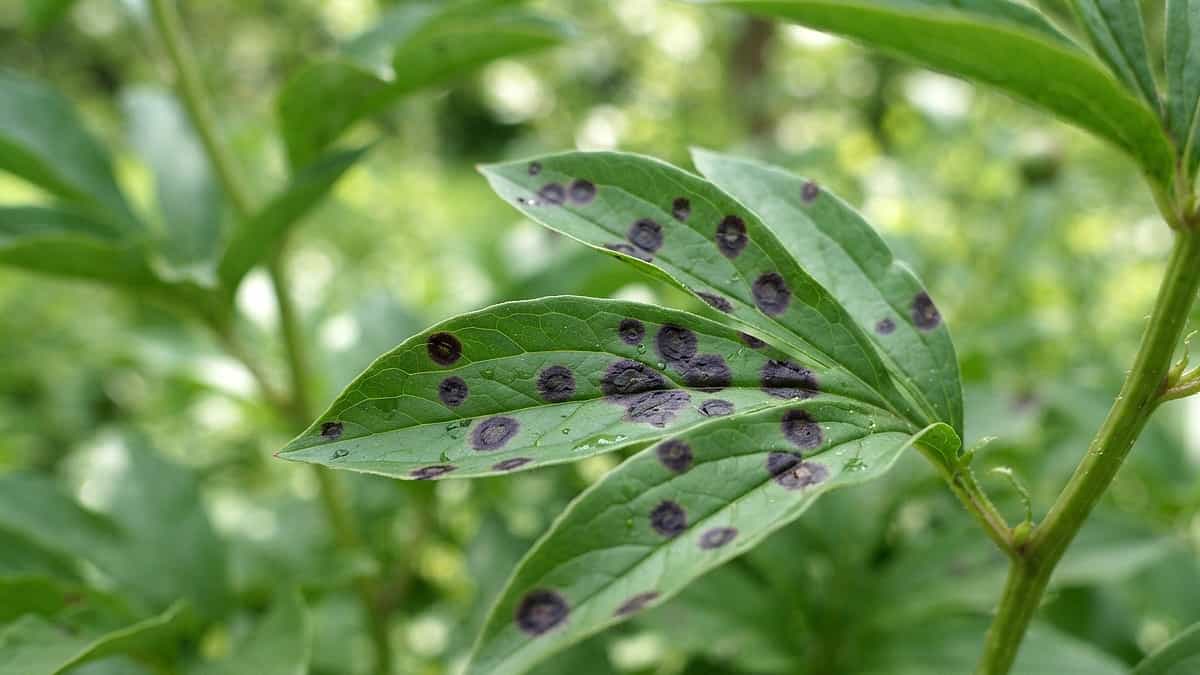
The most frequent cause of black spots on peonies is a fungal disease called leaf blotch, also known as peony measles or red spot. The scientific name is Cladosporium paeoniae.
What it looks like
- ✓ Small, circular purple‑black or reddish‑brown spots on the upper leaf surface.
- ✓ Spots may merge into larger irregular blotches.
- ✓ The lower leaf surface may appear lighter or have a grayish cast.
- ✓ Stems can also develop long, dark purple streaks.
When it appears: Late spring to early summer, often after humid or rainy weather. The disease is rarely fatal but can cause premature defoliation if severe.
Why it happens: The fungus overwinters on fallen leaves and stems. Spores splash onto new growth during spring rains.
What to do: The most effective control is prevention through sanitation. Cut foliage to the ground in fall and remove every leaf – do not compost. Improve airflow by spacing plants 3–4 feet apart. In most gardens, these steps alone stop the disease from spreading year to year.
Botrytis Blight – Black Spots with Mold
Botrytis blight (Botrytis cinerea) is another fungal disease that can cause black or brown spots on leaves – but it usually comes with a telltale sign: gray, fuzzy mold in wet conditions.
What it looks like
- ✓ Black or brown spots on leaves, often starting at the base of the plant.
- ✓ A gray, fuzzy growth on infected tissue when humidity is high.
- ✓ Young shoots may rot at the soil line and collapse (damping off).
- ✓ Flower buds turn black and fail to open (bud blast).
How it spreads: Botrytis thrives in cool, wet springs. Spores are airborne and also overwinter on plant debris.
Why it matters: Botrytis is more aggressive than leaf blotch. It can kill stems outright and significantly weaken the plant.
What to do: Remove and trash infected leaves and stems immediately. Improve air circulation – do not crowd peonies. Water at the base only. In persistent cases, apply a copper‑based fungicide or chlorothalonil in early spring as shoots emerge.
Phyllosticta Leaf Spot – Small Black Dots
A third, less common fungal disease is Phyllosticta leaf spot. It produces very small black dots (pinhead size) scattered across the leaves.
What it looks like
- ✓ Tiny, round black spots (1–2 mm) with light centers.
- ✓ Spots may be surrounded by a yellow halo.
- ✓ Leaves can turn yellow and drop early if infection is heavy.
Is it serious? Usually not. Phyllosticta is mostly cosmetic. Healthy peonies tolerate it without major harm.
What to do: The same sanitation and airflow practices that control leaf blotch also work for Phyllosticta. No special treatment is needed.
Black Spots vs. Natural Aging – How to Tell
Not every dark mark on a peony leaf is a disease. As leaves age toward the end of summer, they naturally develop dark speckles and yellow patches before dying back.
UPSIDES
- ✓ Appear in late spring/early summer.
- ✓ Defined edges, often purple-black.
- ✓ May feature concentric rings or fuzzy mold.
DOWNSIDES
- ✕ Appears in late summer/early fall (August onward).
- ✕ Random yellowing and browning rather than uniform spots.
- ✕ No mold or defined lesions.
When to worry: If spots appear before July and are spreading, investigate. If spots appear in September – do nothing; the plant is simply preparing for dormancy.
Should You Remove Leaves With Black Spots?
Yes – but with a strategy.
| Extent of Infection | Action |
|---|---|
| A few scattered spots | Leave them. The leaf still provides energy. Remove only if spots multiply. |
| Many spots covering 30–50% of the leaf | Cut off the affected leaf at the stem. Trash it. Do not compost. |
| Whole plant heavily infected | Remove the worst leaves. After the first hard frost, cut everything to ground and trash. |
Do not defoliate the plant entirely during the growing season. Peonies need leaves to store energy for next year. Even spotted leaves photosynthesize.
How to Prevent Black Spots Next Season
Prevention is far easier than cure. Follow this checklist:
Prevention Checklist
- Fall cleanup is non‑negotiable. Cut foliage to ground level after the first hard frost, remove every leaf/stem, and trash them (never compost).
- Space plants 3–4 feet apart to ensure good airflow that keeps leaves dry.
- Water at the base using a soaker hose or water gently at soil level to prevent overhead spore spread.
- Water in the morning so any accidental leaf wetness dries quickly.
- Remove weeds and nearby vegetation that block air movement around the crown.
- Apply a thin layer of mulch, but keep it clear of the crown to avoid trapping moisture against the stems.
- In severe cases, apply a preventative fungicide like copper soap or chlorothalonil in early spring as shoots emerge.
Do Black Spots Mean Your Peony Will Die?
No. Black spots are rarely fatal to peonies. Even heavily infected plants usually survive and bloom the following year – provided you practice good fall sanitation.
What you might see: Leaves may drop early, reducing the plant’s energy reserves. That can lead to fewer blooms next spring. But the root system remains alive and will recover.
The exception: If black spots are caused by severe botrytis that also rots the crown (the base of the plant), the peony may die. Crown rot is uncommon but possible in very wet, poorly drained soil.
If your peony has been severely affected for multiple years, consider moving it in fall to a sunnier, better‑drained location with more airflow.
Related Articles

Best Peony Bush Varieties for Home Gardens

Can You Grow Peony Bushes in Warm Climates?