
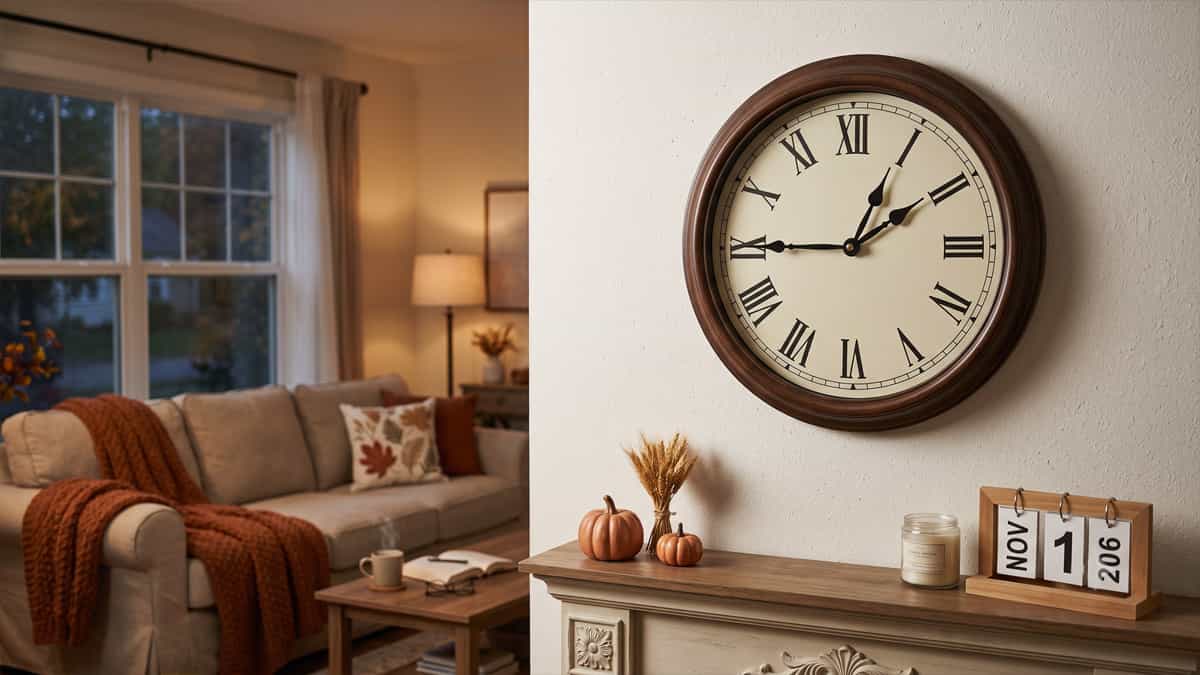
The 2026 clock fall back date in the United States is Sunday, November 1, 2026.
In most parts of the U.S. that observe Daylight Saving Time, clocks will move back one hour from 2:00 a.m. to 1:00 a.m. when Daylight Saving Time ends.
The change gives households an extra hour during the overnight period and returns the affected areas to standard time.
2026 Clock Fall Back Date at a Glance
| Detail | 2026 |
|---|---|
| Fall Back Date | Sunday, November 1, 2026 |
| Clock Change | 2:00 a.m. → 1:00 a.m. |
| Change | Back 1 hour |
| Daylight Saving Time Ends | November 1, 2026 |
| Next Spring Forward | March 14, 2027 |
| Next Fall Back | November 7, 2027 |
The U.S. follows a schedule in which Daylight Saving Time ends on the first Sunday of November. The National Institute of Standards and Technology confirms November 1 as the 2026 end date. NIST Daylight Saving Time information
When Do Clocks Fall Back in 2026?
For most of the United States, clocks will fall back on Sunday, November 1, 2026.
At 2:00 a.m., clocks move backward one hour to 1:00 a.m.
This means the hour between 1:00 a.m. and 2:00 a.m. happens twice.
If you go to bed before the change and wake up after it, the overnight period can feel like it has an extra hour.
What Time Do Clocks Go Back?
The 2026 fall-back transition happens at:
2:00 a.m. → 1:00 a.m.
The clock moves back one hour, changing from Daylight Saving Time to standard time.
Because the change happens overnight, many people will not notice it happening. Smartphones and other connected devices will often make the adjustment automatically.
Why Does Daylight Saving Time End on November 1?
Under the current U.S. schedule, Daylight Saving Time ends on the first Sunday of November.
November 1, 2026, happens to be a Sunday, making it the earliest possible fall-back date under that rule.
The 2026 U.S. Daylight Saving Time period begins on March 8 and ends on November 1. NIST Daylight Saving Time information
What Happens When the Clocks Fall Back?
When the clock reaches 2:00 a.m., it moves back to 1:00 a.m.
So the sequence looks like this:
1:00 a.m. → 2:00 a.m. → 1:00 a.m.
The 1:00 a.m. to 2:00 a.m. period occurs twice.
For households, the practical changes include:
- An extra hour during the overnight period
- Earlier sunrise by the clock
- Earlier sunset by the clock
- The return to standard time
- A change in the time shown on manually operated clocks
Do You Get an Extra Hour of Sleep?
The fall-back transition creates an extra hour in the overnight clock schedule, but that does not automatically mean everyone gets an extra hour of sleep.
For example, someone who normally sleeps from 11:00 p.m. to 7:00 a.m. may have the opportunity to sleep longer because the clock repeats an hour.
But people with early work schedules, children, pets or fixed routines may still wake up according to their usual body clock.
The change can also temporarily affect sleep schedules.
What Happens to Sunrise and Sunset?
After clocks fall back, daylight appears at earlier clock times.
In general:
Sunrise: appears earlier on the clock
Sunset: appears earlier on the clock
This does not mean there is suddenly more daylight. The clock simply shifts back by one hour.
The exact sunrise and sunset times depend on where you live in the United States.
Which U.S. States Do Not Fall Back?
Most U.S. states observe Daylight Saving Time, but there are exceptions.
Hawaii
Hawaii does not observe Daylight Saving Time, so its clocks do not move backward on November 1.
Arizona
Most of Arizona does not observe Daylight Saving Time.
The Navajo Nation is an exception and observes Daylight Saving Time.
Several U.S. territories also do not observe the seasonal clock change.
So November 1, 2026, is not a fall-back date for every U.S. location.
2026 Fall Back by U.S. Time Zone
For U.S. locations observing Daylight Saving Time, the transition occurs at 2:00 a.m. local daylight time.
| U.S. Time Zone | Clock Change | Standard Time After |
|---|---|---|
| Eastern Time | 2:00 a.m. → 1:00 a.m. | EST |
| Central Time | 2:00 a.m. → 1:00 a.m. | CST |
| Mountain Time | 2:00 a.m. → 1:00 a.m. | MST |
| Pacific Time | 2:00 a.m. → 1:00 a.m. | PST |
| Alaska Time | 2:00 a.m. → 1:00 a.m. | AKST |
The exact application of Daylight Saving Time depends on the location.
Do Phones Change Automatically When Clocks Fall Back?
Most modern smartphones automatically adjust their clocks when automatic date, time and time-zone settings are enabled.
The same is generally true for computers, tablets and many connected household devices.
Before November 1, check that:
- Automatic date and time is enabled.
- Automatic time-zone selection is enabled.
- Your device has the correct location or time zone.
- The operating system is up to date.
If these settings are correct, you normally do not need to manually change your phone’s clock.
Which Household Clocks Need to Be Changed?
Not every clock in your home is smart enough to update automatically.
You may need to manually check:
- Wall clocks
- Alarm clocks
- Analog watches
- Car clocks
- Microwave clocks
- Oven clocks
- Coffee maker clocks
- Digital alarm displays
- Older electronic devices
This is one of those twice-a-year household jobs that is easy to forget until the clock on the microwave suddenly disagrees with your phone. 😄
Fall Back Is a Good Time to Check Home Devices
The clock change can also be a useful reminder to check a few household systems.
While you are adjusting clocks, consider checking:
- Smoke alarm batteries
- Carbon monoxide detector batteries
- Home security system settings
- Programmable thermostats
- Appliance clocks
- Automatic lighting schedules
- Smart-home routines
Not every device needs maintenance when the clocks change, but the seasonal transition is a convenient reminder to make sure important household systems are working correctly.
Fall Back vs. Spring Forward
The two annual clock changes move in opposite directions.
| Clock Change | What Happens |
|---|---|
| Spring Forward | Clocks move ahead 1 hour |
| Fall Back | Clocks move back 1 hour |
| 2026 Spring Forward | March 8, 2026 |
| 2026 Fall Back | November 1, 2026 |
| 2027 Spring Forward | March 14, 2027 |
| 2027 Fall Back | November 7, 2027 |
The fall-back transition gives the clock an extra repeated hour, while spring forward removes an hour from the overnight clock schedule.
How Does Fall Back Affect Families?
The clock change can be noticeable for families with established daily routines.
Children may wake earlier than expected according to their body clocks, while adults may need a few days to adjust their normal sleep schedules.
Pets can also be surprisingly unimpressed by the new schedule. Their internal clocks did not receive the memo. 🐶
A gradual adjustment to bedtime and wake-up time can make the transition easier for some households.
How Does Fall Back Affect Home Schedules?
A one-hour clock change can affect everyday routines such as:
- Breakfast and school schedules
- Work and commuting times
- Meal times
- Exercise routines
- Children’s bedtime
- Pet feeding schedules
- Outdoor activities
- Automatic lights
- Heating and cooling schedules
Smart-home devices that use local time should normally adjust automatically if their time-zone settings are correct.
What Should You Do the Night Before Fall Back?
You do not need to stay awake until 2:00 a.m. to change every clock.
For manual clocks, simply change them before going to bed.
A simple checklist is:
- Check your alarm clock.
- Check wall clocks.
- Check kitchen appliance clocks.
- Check your car clock.
- Check watches that do not update automatically.
- Confirm automatic time settings on phones and computers.
- Check important alarms or scheduled devices.
Then enjoy the extra hour. That’s the whole point. ☕
2026 Clock Fall Back FAQs
When do clocks fall back in 2026?
In most of the United States, clocks fall back on Sunday, November 1, 2026.
What time do clocks go back in 2026?
At 2:00 a.m., clocks move back to 1:00 a.m.
Do clocks go back one hour?
Yes. The fall-back transition moves clocks back exactly one hour.
Do we gain an hour when clocks fall back?
The 1:00 a.m. to 2:00 a.m. period occurs twice, creating an extra hour in the overnight clock schedule.
Is November 1 the earliest possible fall-back date?
Yes. Under the current U.S. rule, Daylight Saving Time ends on the first Sunday of November. November 1 is the earliest possible date.
Do all U.S. states change their clocks?
No. Hawaii and most of Arizona do not observe Daylight Saving Time. Some U.S. territories also do not change their clocks.
Does Arizona fall back in 2026?
Most of Arizona does not observe Daylight Saving Time and therefore does not fall back on November 1. The Navajo Nation observes DST.
Does Hawaii fall back in 2026?
No. Hawaii does not observe Daylight Saving Time.
Will my phone change time automatically?
Most modern phones will automatically update when automatic date, time and time-zone settings are enabled.
What about my microwave and oven clock?
Many household appliances do not change automatically. Check them manually after the fall-back transition.
When is the next U.S. clock change?
The next scheduled U.S. clock change after November 1, 2026, is March 14, 2027, when clocks move forward one hour.
When is the next U.S. fall-back date?
The next scheduled U.S. fall-back date is November 7, 2027.
Final Takeaway
The 2026 clock fall back date in most of the United States is Sunday, November 1, 2026.
At 2:00 a.m., clocks move back to 1:00 a.m., ending Daylight Saving Time and returning participating areas to standard time.
The 2026 fall-back date is especially notable because November 1 is the earliest possible first-Sunday-of-November date under the current U.S. schedule.
Most smartphones and computers will update automatically, but household clocks such as microwaves, ovens, wall clocks and some car clocks may need to be changed manually.
So if you’re wondering when to set the clocks back in 2026, remember:
Sunday, November 1, 2026 — 2:00 a.m. becomes 1:00 a.m.